
Affiliate buying guide · Personalized Gifts
Custom Puzzle From Photo: Picture Quality, Size, and Piece Count
Pickorvia buying guide · Affiliate product links
Compare custom photo puzzles
See the actual product options discussed below. Tap a product image or orange button to visit its CanvasChamp listing. Verify size, customization, final price and delivery before ordering.
Product images are illustrative of merchant listings, not proof of a tested purchase. Prices and configurations may change. Choose and confirm your exact options on CanvasChamp.
A custom puzzle from photo is a physical printed jigsaw in this guide, not a free online puzzle maker. Choose the recipient’s preferred challenge, a photograph with useful visual clues, and a finished size that fits the available table. Only then choose the piece count. A familiar picture can still make a difficult puzzle if most of it is dark, repetitive, or empty.
This guide evaluates product information and design choices; we have not ordered or assembled the featured puzzles. CanvasChamp’s US listings were checked on November 15, 2026. The examples are editorial illustrations, not manufactured samples. Read how we assess product information for the distinction between listed options and tested performance.
Choose difficulty for the recipient
Start with what the recipient already enjoys assembling. Ask about a recent puzzle, its size, and whether they liked the challenge. For a shared activity, consider the least enthusiastic participant as well as the most experienced. A higher count is not automatically a more generous gift if it makes the activity frustrating or takes over the only dining table.
For someone who does not enjoy jigsaws, compare other photo gifts for grandparents or personalized gifts for him rather than choosing a puzzle by piece count alone.
| Listed piece-count route | Editorial use case | Image choice | Space and piece-size check |
|---|---|---|---|
| 100 pieces | Fewer loose pieces to manage | A clear main subject with distinct regions | Confirm finished inches and actual piece dimensions |
| 200 pieces | An intermediate option to compare | Several recognizable colors and features | Do not infer piece size from count alone |
| 500 pieces | A recipient who enjoys a longer sorting task | Varied detail across the frame | Allow working room beyond the finished footprint |
| 1,000 pieces | Someone who actively wants a substantial project | A detailed scene with useful landmarks | Confirm a place to leave or store unfinished work |
These are selection suggestions, not completion-time estimates or age ratings. CanvasChamp has separate listings for these counts, but the precise size and cut configuration still need confirmation in the editor. Actual piece dimensions were not independently established for each variant, so we do not assign them invented measurements.

For grandparents, a partner, or a friend, ask whether they want an activity at all. A photo book or print may suit the same photograph better. If the puzzle is intended for children, check the exact product’s warnings and intended age guidance; a general gift description does not establish suitability.
Piece count does not determine difficulty by itself
Imagine two pictures used at the same count: a colorful street with distinct windows and signs, and a pale beach with a large uninterrupted sky. The first offers many location clues; the second asks the assembler to distinguish subtle colors and shapes. This is a design comparison, not a timed experiment.
Repeated fur, grass, water, or brick can be challenging even in a meaningful photo. A blurred background may look attractive in a portrait but provide few assembly clues. If the recipient enjoys that kind of challenge, keep it. If the goal is an approachable family activity, choose a picture with more distinct areas.
Choose a photo that makes a satisfying physical puzzle
To make a puzzle from a picture, begin with the highest-quality original available. Inspect the photograph beyond the main face: look at corners, shadows, and background areas that will become separate pieces. A strong photo puzzle image gives the recipient something to recognize throughout the design, not just in one small central patch.
A travel scene with different buildings, clothing colors, and a clear horizon can work well. A pet portrait can work too, especially when the background provides contrast and variety. Keep realistic expectations for tiny faces in a distant group photograph. Enlargement does not guarantee that expressions absent from the source will become visible.
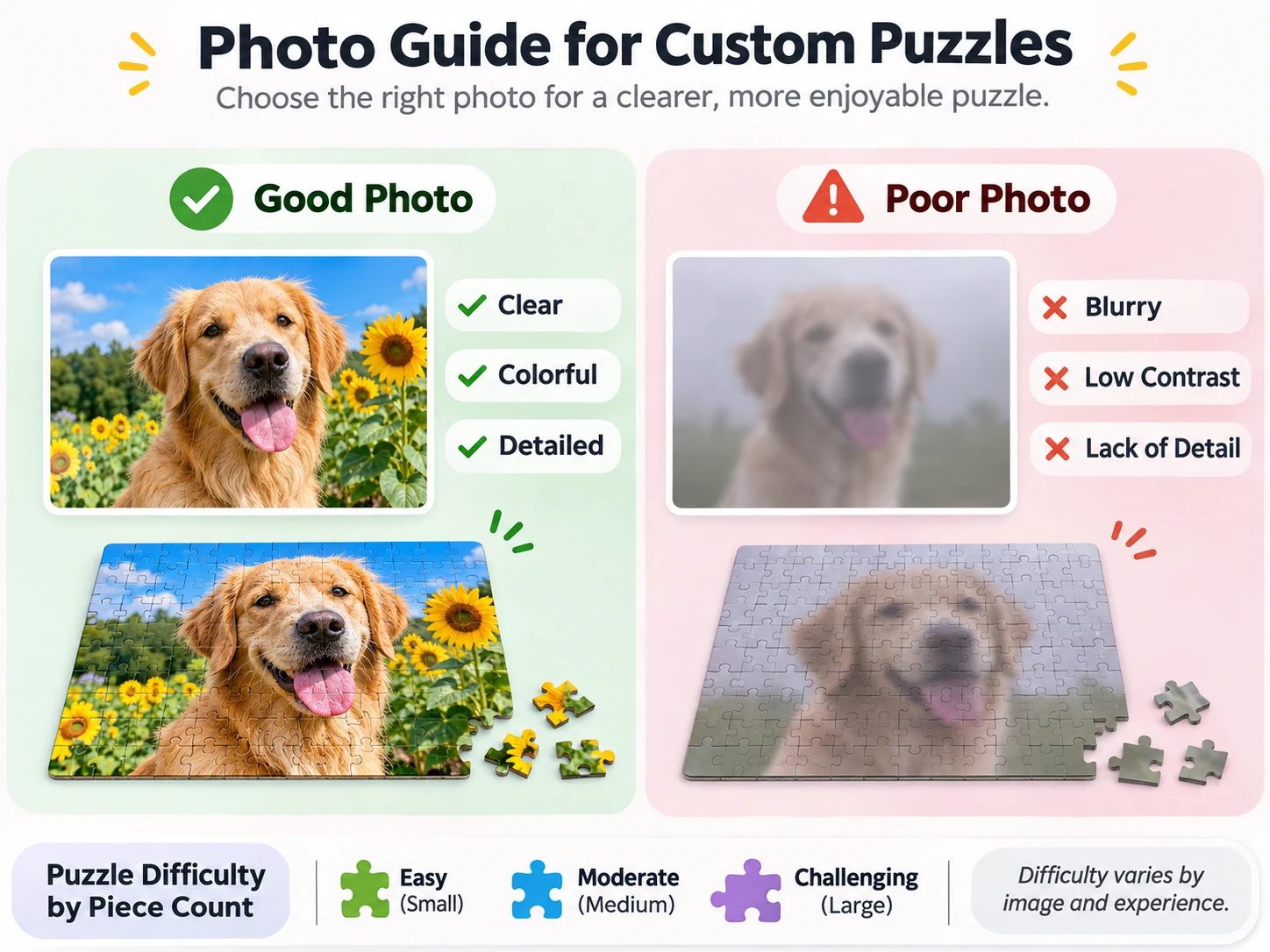
Faces, repeated backgrounds and collages
A dominant portrait makes the finished image personal, but piece boundaries can pass through facial features. Do not assume the seller will place cuts around eyes or mouths unless that service is explicitly confirmed. If a particular cut would upset the recipient, another format may be a better match for the photo.
Collage boundaries can create useful visual regions. However, too many panels shrink each face and may produce repetitive borders that are difficult to distinguish. Choose a small group of related images and test their visibility in the intended layout. Avoid using nearly identical photographs simply to fill available spaces.
Check resolution and crop before upload
Check pixel dimensions after cropping. As a planning example, a 3,000-by-2,000-pixel landscape spread over a 15-by-10-inch rectangle provides 200 pixels per inch in each direction. That calculation describes the file density; it is not a universal acceptance threshold or a promise of sharp output. The actual source focus and printer requirements still matter.
CanvasChamp’s 100- and 200-piece pages cite 3,409 by 2,567 pixels, while the 1,000-piece page cites 4,530 by 3,409. Treat these as listing-specific guidance to confirm for the selected dimensions, not rules for every custom photo jigsaw puzzle. The pages contain varying size descriptions, so the exact configuration needs a final check.
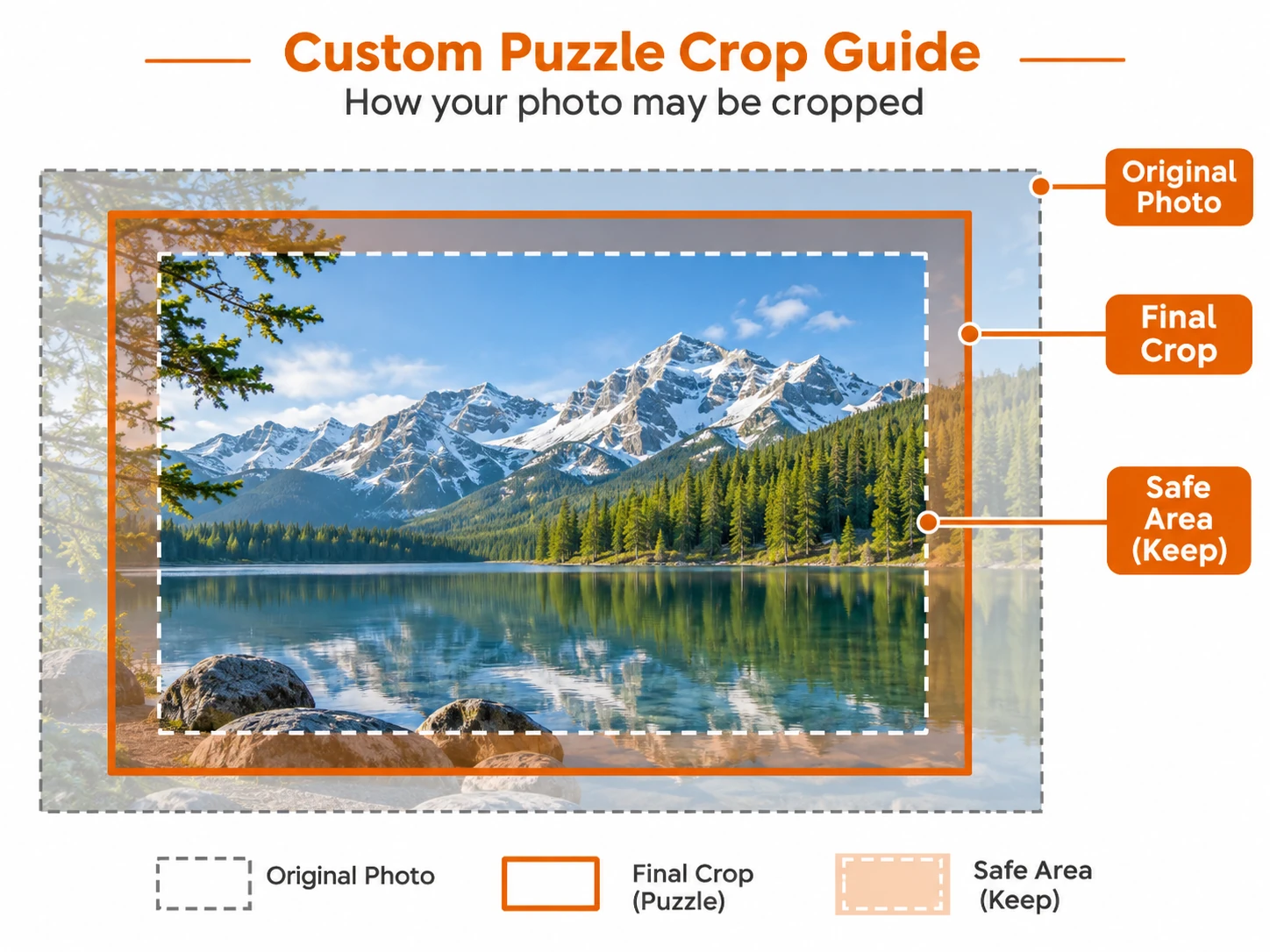
Protect important faces and text from the crop boundary. A landscape photo fitted to a square loses content unless a border or different layout is used. Do not stretch the image to make it fit: that changes proportions. If the preview cuts off a person, choose another shape, change the crop, or use a different photograph.
Compare the finished product and order terms
Compare what will physically arrive, not just the count. Check material, finished dimensions, shape, print surface, packaging, reference image, and how a missing or damaged piece would be handled. We have not measured piece fit or verified a universal material specification across all CanvasChamp puzzle variants.
Before ordering, review CanvasChamp before ordering to understand merchant-wide questions and policies.
| Product question | Evidence from the listings | What remains to confirm |
|---|---|---|
| Piece-count routes | Separate 100, 200, 500, and 1,000 listings | Exact selection carried into the cart |
| Shapes | Several shape choices are described | Shape available with your size and count |
| Finished dimensions | Descriptions vary across product pages | Exact dimensions for the selected order |
| Packaging | Main listing describes an optional storage box | Included contents and any extra charge |
| Cut and material | General marketing descriptions | Specific construction and piece dimensions |
For a fair cost comparison, keep size, shape, piece count, box, and destination constant. A lower headline price may refer to a different combination. Review the total USD, including shipping and tax, and save the selected options. If a required detail is unavailable, ask support rather than guessing from a neighboring product page.
A gift box and reference image are separate checks
A storage box protects loose pieces; a printed reference image helps the recipient see the target picture. They are related but not interchangeable. Ask whether the image appears on the lid, on a separate sheet, or in another form, and whether the box is included with the exact chosen variant.
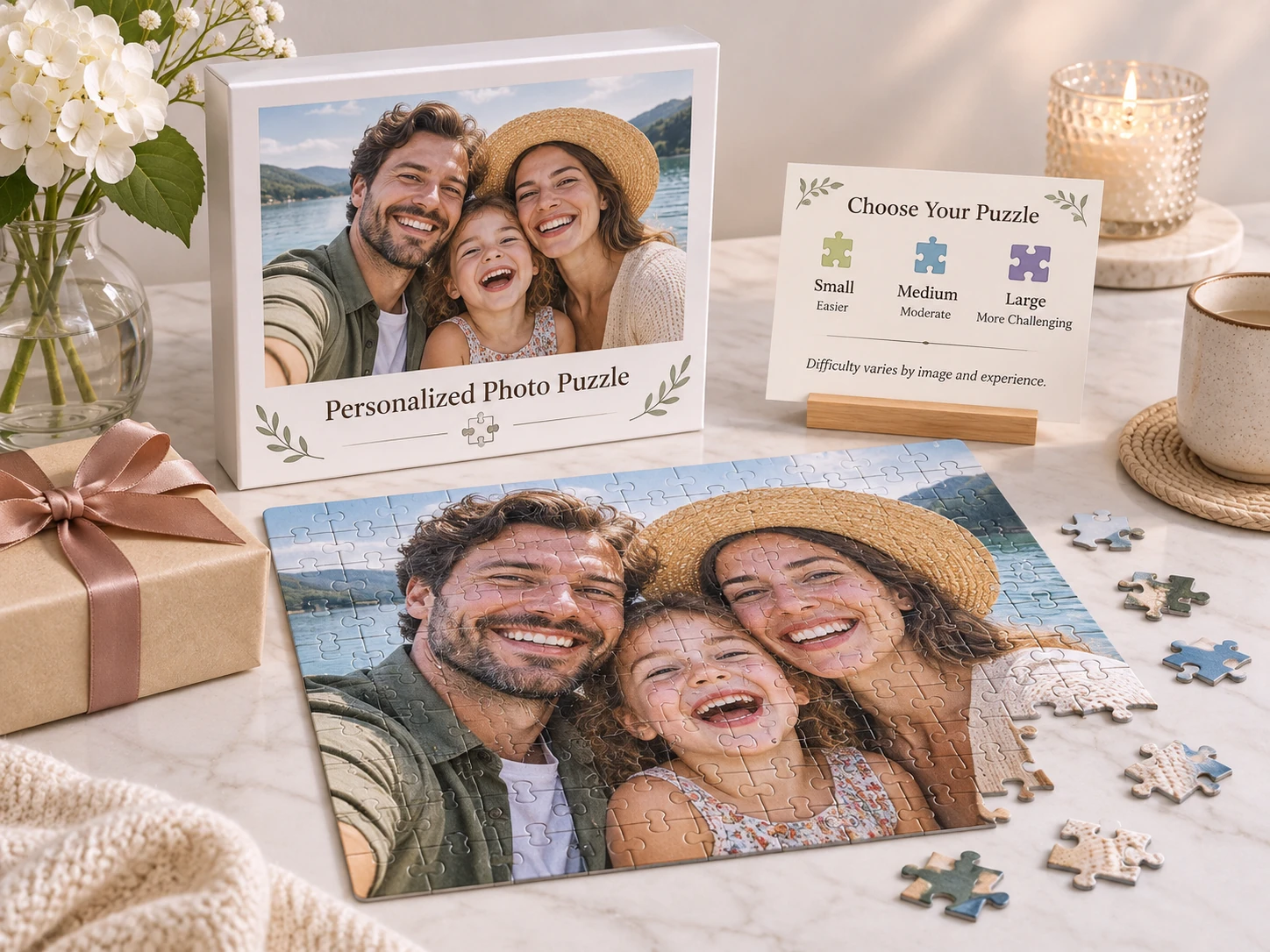
The packaging illustration above is conceptual and is not documentation of CanvasChamp’s box. If presentation matters, obtain confirmation before ordering or plan your own suitable container after delivery. Also think about whether seeing the completed picture immediately is desirable: most assemblers use a reference, but some prefer the image to emerge gradually.
Preview and order the physical puzzle
Review orientation, crop, text, and the final selected dimensions before approving the order. Zoom in enough to inspect faces, then zoom out to judge the whole composition. A preview shows placement; it cannot establish how tightly pieces fit or how the surface feels. Keep a copy of the original and the approved layout.
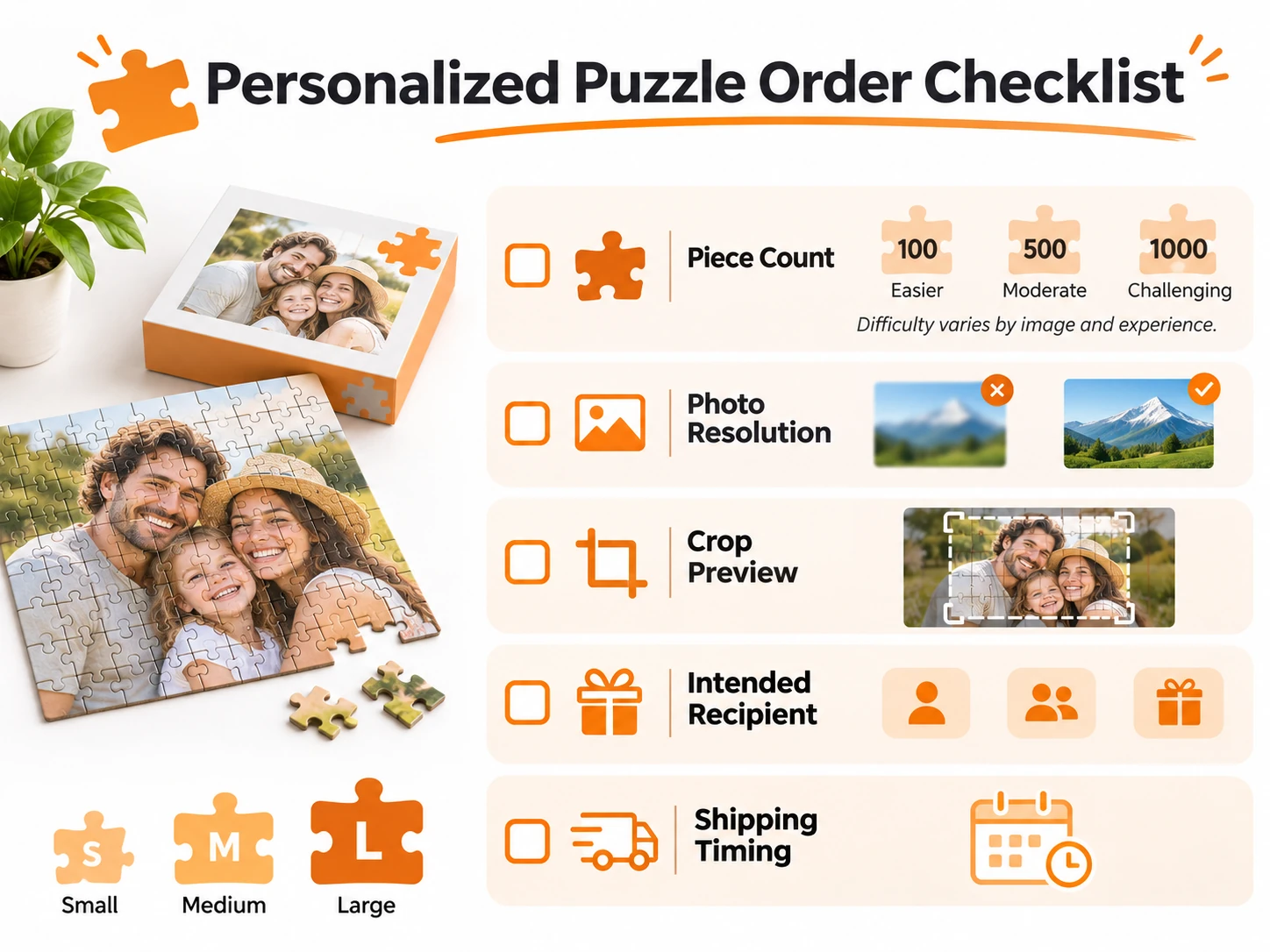
Check the address and order-specific delivery estimate, especially if the puzzle is a gift for an event. Read the customer-service FAQ and ask how the applicable correction process works. Public policy wording differs from the longer return period in the terms, so report any issue promptly and obtain instructions before returning an item.
After delivery, inspect the package and compare the image with the approved design. Keep the pieces contained while checking the contents. If a problem appears, record the order number and clear photographs. Do not assume a replacement for one piece is available; ask whether the seller handles missing-piece claims by replacement, reprint, or another process.
When a puzzle is not the best format
A personalized photo gift should match the recipient’s interests. If they prefer looking at a picture to assembling it, choose a print or book. A pet portrait blanket may suit an owner who wants a textile keepsake. A broader recipient-based gift decision is useful when the photograph is settled but the physical object is not.
For a pet photograph that would be better enjoyed as a textile keepsake, compare a pet portrait blanket.
A photo cube is a different activity from a flat jigsaw. It can suit someone who already enjoys twisty puzzles, but it should not be presented as a simpler version of the same task. Image orientation and small faces also require care because the photographs are divided across rotating sections.
If the request is for a free playable puzzle, an online photo-puzzle tool is the relevant category instead. Check its upload privacy and sharing controls before using personal family images. A physical affiliate product does not answer that digital need, and there is no reason to order an object when the recipient wants an on-screen activity.
Frequently asked questions
Can I make a physical puzzle from a phone photo?
Yes, provided the original has enough usable detail for the selected output. Check focus and cropped pixel dimensions rather than the phone model. Request an uncompressed original if possible, then use the merchant’s file guidance and preview. A bright thumbnail is not enough to establish how a larger image will reproduce.
Is a photo puzzle the same as an online puzzle maker?
No. A physical photo puzzle is manufactured and shipped, while an online puzzle maker turns an uploaded image into a screen-based activity. The costs, privacy considerations, and recipient experience differ. This article’s product recommendations are for physical objects; choose a digital tool if that is the experience you want.
Can I request a particular piece count or custom shape?
Choose among the combinations the merchant currently supports, or ask whether a special configuration is possible. A page describing several shapes does not mean each shape is available at every count and size. Confirm the exact selection in the cart rather than copying an option from another seller or assuming a fully custom cut is included.
Final selection: match the photo, challenge and format
A good order combines a welcome activity, a readable photograph, and a practical footprint. Confirm piece count, finished size, crop, packaging, reference image, and delivered cost before paying. Choose a lower count or a more varied image when the goal is relaxed shared time; choose a larger project only when the recipient wants it.
The cards above let you inspect the relevant physical-puzzle options after those checks. If the picture is too weak, the dimensions are unclear, or the recipient dislikes jigsaws, choose another format. A familiar photo should improve the gift’s fit, not become a reason to overlook the activity itself.